

Active, colorful, enchanting, and simple to care for, it’s no wonder neon tetras are so popular.
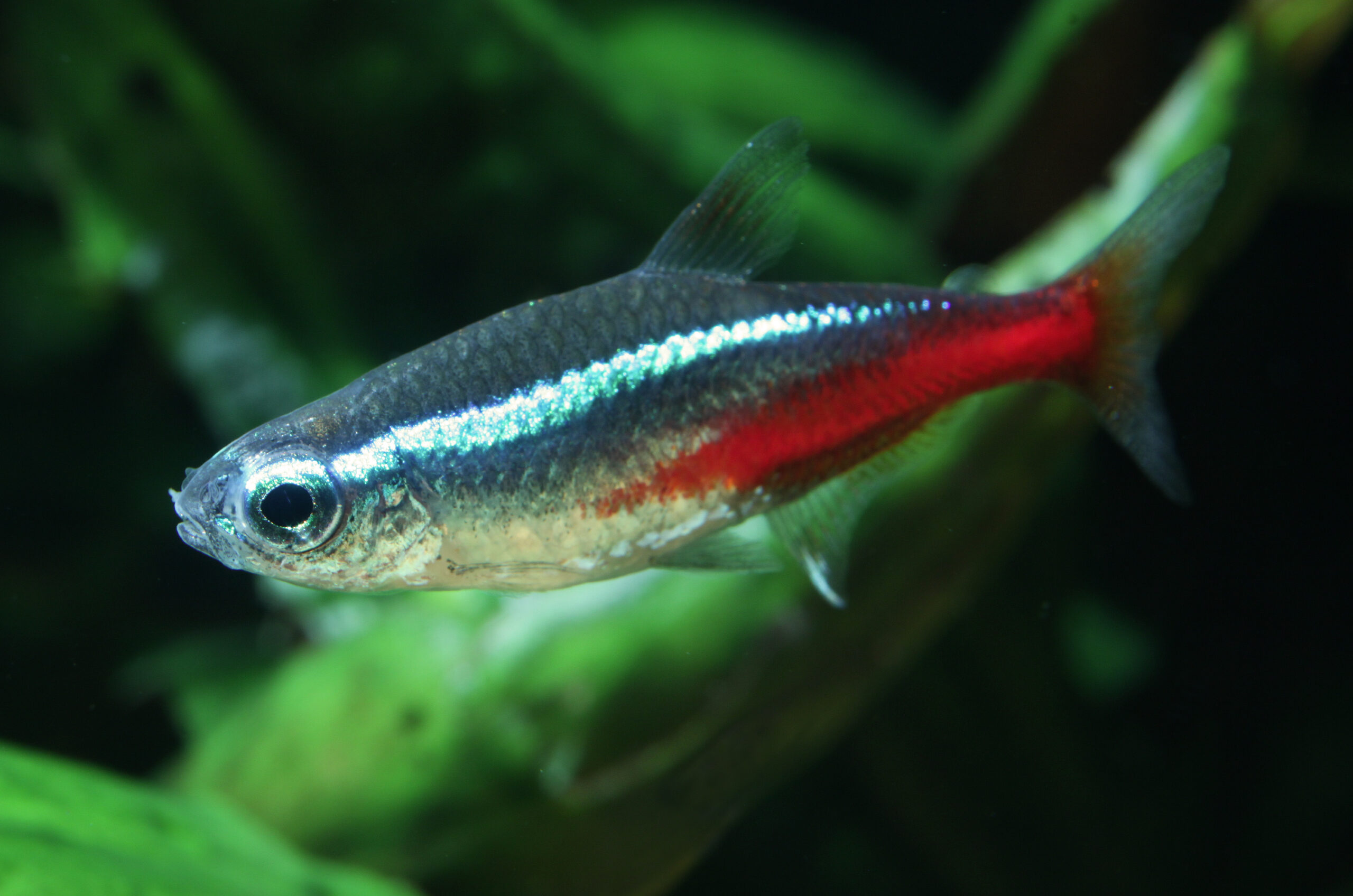
Neon tetras are small tropical freshwater fish with a bright red stripe and light blue electric colouration.
They can be seen in virtually every tropical fish shop around the world and sell in their millions every year. Native to Peru, Colombia and Brazil these tiny colorful fish reach a maximum size of just 3cm in length, making them suitable for smaller tropical aquariums.
Neon tetras belong to the family Characidae, which includes Piranha and huge, walnut-eating Pacu, but in general, tetras are small, peaceful schooling fish inhabiting rivers and streams in South America and Africa. Neon tetras inhabit small forest streams where their bright colours enable them to locate each other in the gloom as well as dazzling and confusing any would-be predators. They live in number in the wild and need to be kept in shoals of ten or more in the aquarium.
Neon Tetra Care: Tank Setup Guide
Let’s go through the process of how you can set up your own Neon Tetra aquarium.
How Many Neons Should You Get?
Neons really should be kept in a school, as large a group as you can manage. In the wild, they shoal together in vast numbers, sometimes in the thousands.
Keeping neon’s in too small a group can make them stressed and unhappy.
Just imagine, you’ve got a large group of friends and you’re used to hanging out with all your friends. But then someone scoops you up with a huge net and puts you in solitary confinement for the rest of your life.
You wouldn’t be too happy about this, and you’d be pretty stressed out, too.
Neons should be kept in a group of at least six. Any less than this and they might start getting nervous and aggressive with each other. Keep in mind, this is an absolute minimum.
The more the merrier with these little guys. Schooling fish feel more secure when they can gang together with a lot of the same species and rely on safety in numbers.
They will also school more tightly with a large group, which is awesome to see in the tank.
And do not get just two. If one of the neon’s starts to get aggressive, it only has one other fish to pick on.
Just picture a schoolyard bully with only one kid to push around. The pitiful thing will just get pounded to death.
With a larger group, that aggression gets spread out so no one fish is singled out and harassed all the time.
Breeding Neon tetras
Although bred commercially, Neon tetras are not commonly bred in the home aquarium since the eggs are so small, they get eaten by other fish, and are sensitive to light. A separate breeding tank could be set up especially for breeding, however. Females are slightly larger than males and their bellies swell with eggs.
A pH of 6-7 and a temperature of 24C is ideal. Neon tetras can tolerate slightly cooler water than their cousins the Cardinal tetras, and the two species can be told apart by the solid red colouration on Cardinal tetras and the Cardinal’s slightly larger size. Cardinals prefer even warmer water at 28C, and a pH as low as 4, although a pH of around 6 is easier to maintain long term and more stable. Both belong to the Genus Paracheirodon, with Neons being Paracheirodon innesi and Cardinals Paracheirodon axelrodi.
There is a third neon tetra fish species called the green neon tetra, Paracheirodon simulans, which looks like a small combination of the two. Green neons need soft water and groups too and can be kept in much the same way. Then there are the line bred variants of the captive-bred Neon tetra including longfin, albino or golden, and Diamond. Black neon tetras are a distinct species, Hyphessobrycon herbertaxelrodi, but can be kept in the same way as Neon tetras and are often kept alongside them in the same tank.
Water Parameters for Neon Tetras
Since neons originate from the Amazon River basin, it’s best to mimic these conditions as much as possible.
This means soft, slightly acidic water is best for them.
- Temperature: 72°-76°F (22.2°-24.4°C)
- Ammonia: 0 ppm
- Nitrite: 0 ppm
- Nitrate: <20 ppm
- pH: 6-7
- GH: <10 dGH (<166.7 ppm)
- KH: 1-2 dKH (17.8- 35.8ppm)
Tank mates for Neon tetras
Neon tetras are timid aquarium fish that need similarly sized, peaceful tank mates. Corydoras are bottom-dwelling catfish that make perfect partners for tetras. Pencilfish, hatchetfish and dwarf cichlids like Apistogramma are suitable too and together make a South American themed biotope aquarium. Larger fish like Angelfish and Pictus catfish are known Neon tetra eaters, as are most fish of four inches or larger, which when the tiny Neons are added to the tank, just think they are live food.
Neons are sensitive to poor water quality and are not suitable for tanks of less than six weeks old, or any levels of ammonia and nitrite above zero. Poor water quality, the stress of fish trying to eat them, and temperature shock can all result in Whitespot disease, so even more reason to ensure that the tank is ready, and the fish are quarantined after purchase. They even have their own disease named after them – Neon tetra disease.
Neons are easy to feed, accepting crumbled tropical fish flakes, micro granules and live or frozen Bloodworm, Brineshrimp, Daphnia and Black mosquito larvae. Feed little and often. Three feeds per day are not excessive and help these tiny fish with fast metabolisms maintain weight and growth.
What Kind of Filtration do Neon Tetras Need?
Neons don’t necessarily have specific filtration needs.
The biggest thing to remember is to get a filter that is rated for the volume of your tank. That way, you should have enough capacity for the beneficial bacteria that process ammonia.
Look for the GPH rating (gallons per hour), and make sure it’s 4x higher than your tank size and you’ll be good.
Heating a Neon Tank
Neons are most definitely tropical fish. You will absolutely need to add a heater to the tank so that you keep it at a steady 72°-76°F (22.2°-24.4°C).
For breeding, it’s better to keep the tanks at 75°-76°F (23.9°-24.4°C).
Plants and Decor for Neon Terta Aquariums
It’s best to provide your neons with a mixed environment with some open swimming space and lots of plant cover.
They’ll school together in open areas when they feel secure and dart into plants when they feel threatened.
They love tall plants like Ludwigia repens, Brazilian pennywort (also works as a floating plant), vallisneria, cabomba or Cryptocoryne wendtii.
Neons also like floating plants like frogbit, dwarf water lettuce or red river floaters. They’ll swim around in the roots that hang down into the water column.
What To Feed Neon Tetras?
It’s best to mimic this diet in the aquarium:
- Balanced, high quality flake food.
- Sinking micro-pellets.
As a treat:
- Freeze dried or frozen bloodworms.
- Frozen brine shrimp.

